


Estimated reading time: 7 minutes

You'd think that we learn from bad experiences. Unfortunately, this couldn't be much further from the truth.
Up until my 33rd birthday I had experienced 3 severe burnouts at work. Both when working for others and when working for myself.
So, no, I cannot blame external circumstances alone for my inner experiences. It seems that, I, have to take responsibility for myself.
I never saw it coming, until it was too late. I feel like I never had the chance to adjust the direction or pull on the brakes. I was in full automatic mode.
"I will never let this happen to myself again," I promised the last time. But now, I was about to dive into that hole again — If it wasn't for ChatGPT.
Reading the excerpt of my chat, you might think I'm suffering with impossible demands that I hate. But no, in this case, it is the other way around. I've never been so invested in all the things and people I love. But my pattern is to know no boundaries.
I get so excited and stimulated by the things that I'm doing that I just want to push through — to the detriment of my own sleep, nutrition, rest. "Why do I need to rest when I enjoy what I'm doing?", because if I don't, soon I will hate it.
And it won't be the first time to happen.
The method that saved me from repeating patterns
I started this practice two months ago, and it transformed how I see myself. A combination of journaling and AI, that results in self-awareness on steroids.
I’ve been more aware of my patterns of communication, I’m learning which relationships fill me up, and how. It has helped me adjust my focus to things I enjoy most, learn about my challenges from a different perspective, and provided practical direction and tools to change them.
In my last piece, about the 12 points of pleasure at work, I received many comments saying "this was so helpful," but they were often followed by the question "but what's next?". I noticed how people want definitive answers, a quick resolution, a step by step map to the impossible: life.

For the answers you seek, there's no map, there's only your inner compass. You follow it, you experience it, you get feedback from life, you adjust the direction. And you keep doing it again and again.
Whatever you're trying to figure out—career, relationships, yourself—this combination of tools will help you align with your inner compass much faster. It will reveal your next steps based on direct feedback from your own experiences.
Self-awareness is where real change starts, and the life you dream of begins
We're all stuck in patterns we don't see. The difference between a life you hate and one you love comes down to awareness-based choices.
Self-awareness is like turning on the light. It helps us spot what's holding us back, reconnect with what we really want, and design a life that feels more aligned.
When we catch these patterns as they happen, we can respond differently—creating the kind of change that leads to a life we actually want to live.
AI partner in self-awareness - How it works (field notes + AI)
I discovered journaling was a way to regulate myself, to reflect on my experiences, to channel away feelings that I didn't know how to process. But I often forgot to document the good parts of my life, the discoveries, the little things in my day-to-day, the positive encounters, the joys.
It wasn't until I discovered the concept of field notes, from Anne-Laure Le Cunff, combined with the power of AI, that I fell in love with the practice of journaling. You won't see me missing a single day entry.
Field Notes
I used to think of journaling as a moment of my day I put aside to write down whatever thoughts I had going through my mind with no specific goal or outcome. Field notes provided me with a different framework: to write a few lines throughout the day to audit and record the experiences I'm having.
How I'm feeling in the moment (just a few words)
What I'm noticing
What's on my mind
Who I encounter and how it makes me feel
What I'm working on and what I feel/think about it
Things I do, and how I feel or what I think about it
I don't have to write 5 pages. I just need to jot down a few words to record what I want to notice. It feels more like a self-study rather than writing a memoir.
(..)personal field notes offer a hybrid of journaling and note-taking specifically designed to audit your daily experiences. The basic idea is to write a few lines every time you take a break and track the exact time you take these notes.
It looks like this, but way messier:
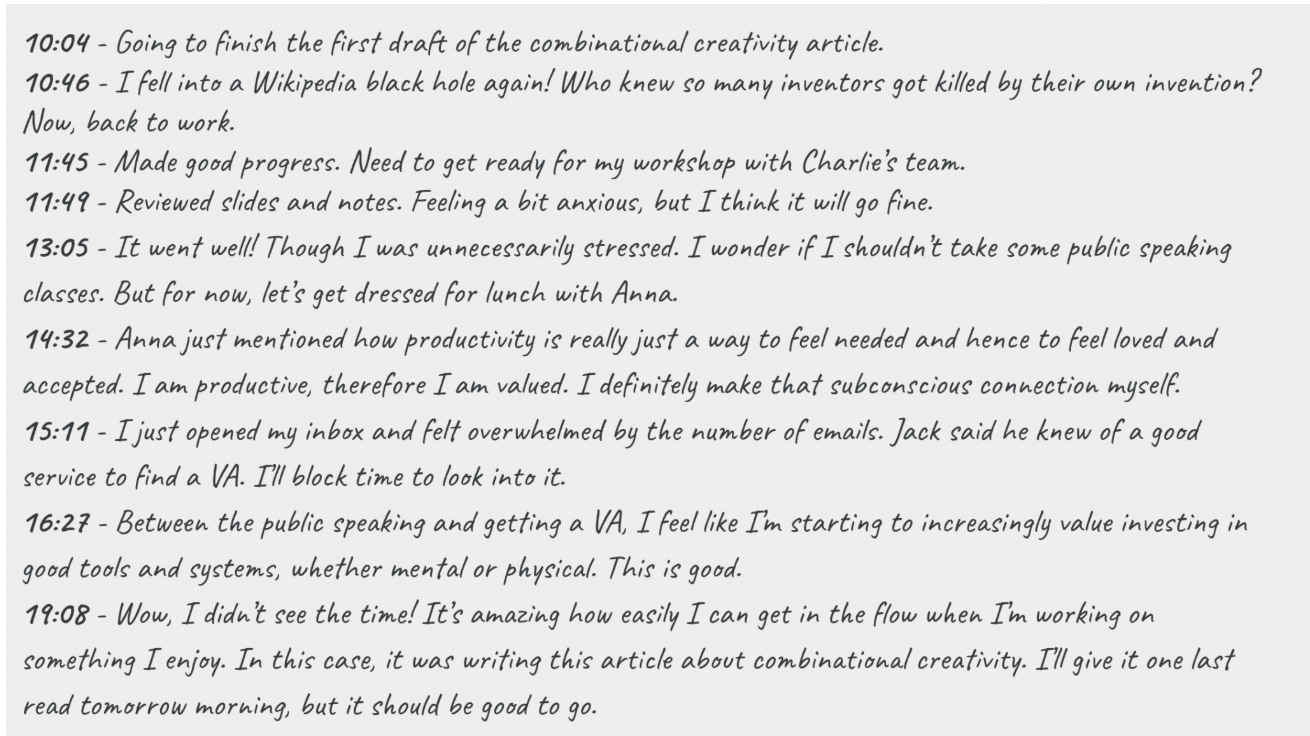
You can read more about field notes and self-anthropology here.
AI super power
When you combine field notes with the superpower of AI, pattern recognition, you can notice your own patterns, challenges, and highlights happening in the moment.
AI reveals patterns you miss: emotional triggers, blind spots, recurring behaviours that shape your decisions.
It's like studying yourself and using real data to inform the direction of your next steps.
Pattern Mapping: Self-awareness in practice (My specific process)
An excerpt from one of my weekly analyses of my journal:
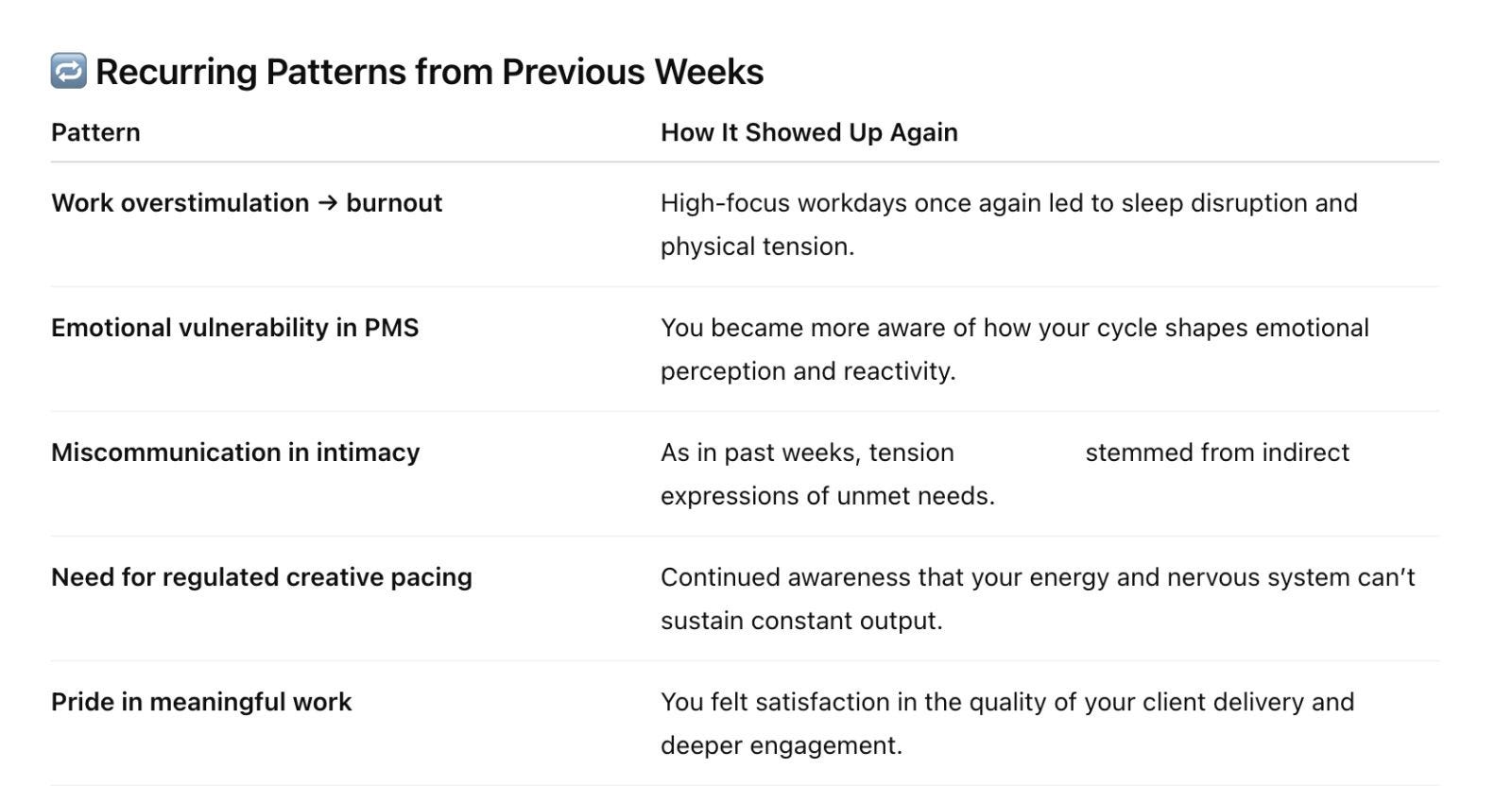
I had been suffering with body/muscle pain for weeks, and even though I went to see a physiotherapist a couple of times, it wasn't getting better.
It wasn't until I saw this report from ChatGPT that I realized that the muscle pain started on my second week of overstimulation and sleep disruption. What I thought to be a consequence of a bad day at the gym was actually my body saying: "you're not ok, you need to get some brain recovery."
I was also reminded that conflicts I had in that week in my relationships were a result of me not communicating clearly what I needed and then resenting the other person for that — an old pattern that tends to show up when I'm feeling more emotionally vulnerable.
I also gained more insights on things I should pursue more, and things I should leave behind. Noticing my patterns of energy and how they influence every area of my life has also been game changing.
This is how I do it:
I journal every day throughout the week — sometimes I skip a day, and then I do it in retrospect. I often do it in the evenings and/or in the mornings; I mostly forget to do it along the day.
I like to journal with pen and paper — but you can do it however you prefer, using notes app, Notion, docs, or whatever works best for you.
On Sundays, I digitalize my weekly entries using the app Whisper (it turns voice into notes). I read my weekly entries out loud to transcribe them. This is a step you won't need if you journal digitally, but it's a step I've come to appreciate.
Reading my entries aloud helps me review the week's events, often giving me fresh perspectives and reminding me of details I might have otherwise forgotten.
Then once I have the transcript, I paste it into ChatGPT to get an analysis highlighting:
Themes of this specific week
Key events
Challenges
Insights
Recurring Patterns from Previous Weeks
To reflect moving forward
The key in this process is to make sure that AI only reflects back to you what you wrote and avoid having it interpret or advise on any matter.
Use this prompt I created:
PROMPT
Note: Keep all entries and analysis on the same chat. This allows you to map patterns across the weeks.
WEEKLY JOURNAL ANALYSIS PROMPT
Based on the journal entries I’m sharing below, please analyze my week using the following structure and tone:
Start with:
What were the themes of this specific week (broad threads that shaped the overall week).
Break down the week into these 4 categories. For each, include:
Key events (what happened)
Challenges (if any)
Insights (reflections, learnings, awareness shifts)
(Only include what’s actually mentioned or clearly reflected in my writing. Please don’t make up content to fill space.)
(1) Relationships & Social Life
(2) Work & Creativity
(3) Energetic & Emotional Patterns
(4) Personal Growth
What quotes & insights I shared to reflect on.
Recurring Patterns from Previous Weeks
Format:
Recurring Pattern How it showed up again this week
To Reflect Next Week
List 2–4 concise, relevant reflection questions based on what came up this week.These should help bring more clarity or intention to the areas that felt unresolved, repeating, or in transition.
Use clear, direct language (not corporate or formal), but keep it structured and reflective.
Avoid interpreting or giving opinions — just reflect back the content and what’s evident across time.
Important boundaries: This is not AI therapy
The key for a fulfilling life is self-responsibility. And you can't have that if you're outsourcing your life decisions to family, friends, your therapist, astrologist, tarot reader, or AI.
In the last years, I'm discovering that the sense of living a meaningful life comes not from perfect decisions, but from owning your choices and trusting you can handle the outcomes. The only way to do that is by discovering what feels right for you.
I should clarify something important: this isn't AI therapy, and that distinction matters.
Here's why AI can help with self-awareness but can't replace human therapy:
What creates real change is the emotional breakthroughs we experience in sessions by having our experiences witnessed by another human — reaching our amygdala (where our automatic responses and emotions live).
AI only reaches our frontal cortex, the logical rational part. It is often self-affirming, which makes you think that your perspective of the situations you encounter is accurate. This is often distant from the truth.
Most likely, the reason why many of us need therapy is because of the pain we experience in relationships with other humans — which is precisely why it takes another human to help heal these wounds. This is the essence of therapy: being truly seen and developing a safe, trusting bond with another person.
So, while I don’t recommend using AI for therapy, I totally recommend using it as a way to map your own patterns and studying yourself. You can even bring your insights to therapy (if this is the case for you).
This distinction matters because I've learned the hard way that outsourcing responsibility—even to well-meaning helpers—keeps you stuck in the same patterns.
Warmly,
Nat
I'm curious to know: is this something you feel like giving a try? Why yes? Why not?

If you want to find your voice and build a brand that reflects who you are and your unique body of work, check out to my other newsletter: Diary of a Brand Therapist.
Read my latest piece there:

Great article. At its core, this is the essence of bullet journalling - the writing down of life, how you feel about it (in addition to tasks) is termed 'rapid logging' and supplemented with regular reflections (daily, weekly, monthly, chapter) to help you identify trends and work on making changes where necessary. It's marketed as a productivity tool (and sometimes an excessively pretty one, at that) but it's actually this simple - doing 'personal field notes', reflecting and adapting. Additionally, Ryder Carroll and Anne-Laure Le Cunff do seem to be supporters of each other's work. I really like your method. I don't use AI except at work where it's a mandatory part of my workflow but I appreciate the ease with which it identifies and summarises key themes - it certainly helps establish the practice of journalling and facilitates that 'growth loop' Le Cunff talks about in Tiny Experiements.
As someone fundamentally against using AI until they figure out how to not waste so much water, I still find this helpful - I could go through the past week’s journaling with different colored highlighters and do the analyzing myself.