

Lately, I’ve received some emails from you sharing your stories. While it makes me really happy that you trust me enough to share bits of your journey, most of them finish with a similar ending: So, what do I do?
The series of emails took me back to the version of myself that, up to a few years ago, also used to ask other people: what should I do?
Since I've outgrown this habit, and my life has gotten much better for it. So here’s what I’ve learned about making decisions for yourself, and how it builds self-confidence and self-trust.
It’s not that you don’t know how to decide; it’s that you worry about what other people will think of it
I think that deep down we all know what we want for ourselves, but what often gets in the way of pursuing that is the fear of what other people will think of us. Will they think I’m choosing wrong? Will they think I’m a loser? Will they think I’m ungrateful? That I don’t care? Will they think this or that about me (fill in with fears in your mind)?
So, we don’t allow ourselves to truly focus on what we want and what matters, because our primary attention is going towards how it will be perceived by others. This can be your friends, your family, people on social media, and also no one but a projection of “others” as a faceless group that you carry on your shoulder or in the back of your mind.
Sometimes “others” are only one single person who you admire for some reason, and while they don’t spend one minute of their lives thinking of you, or knowing that you exist, you still wake up every day trying to prove yourself to them because of what you project in your mind about what they mean.
I made the “right” decision when I accepted a high-paying job years ago, only to find myself crying and drained at the end of the day. I also made the “wrong” decision when I decided to give a second chance to someone who had hurt me deeply, only to end up with the best relationship I could ever dream of.
I put “right” and “wrong” in quotes because those labels reflect how other people viewed my decisions at the time, not how I understood them myself. In both cases, I ultimately did exactly what I wanted. Still, I won’t pretend that external validation played no role: knowing that some people would see me as more impressive for accepting that job likely made it easier to say yes. Likewise, when I decided to give a second chance, I found myself second-guessing not because it felt wrong to me, but because I feared being judged as foolish if it didn’t work out.
One practice that has helped me decide when I get voices in my head is to sit with myself for 10 minutes and for this time being, remove any perceived opinion of others from the equation. That’s when you gain some clarity on what is left for you.
There’s no right or wrong decision, there’s only what is aligned in the moment
Other times, it’s not what other people might think that gets in the way, but the overthinking of all the potential outcomes of a decision, which leads to analysis paralysis.
In essence, there is no wrong or right decision, simply because we can’t foresee how things will play out. Sometimes, we just have to trust life. Also, labeling decisions as right or wrong means that you first have to answer: right or wrong for whom? and with what goals in mind?
The only right decision is the one that feels right for you in the moment according to your intentions, even if your intentions change later.
Eight years ago, I left Brazil for Europe with no plan, no network, and no money, but the little I had saved to cover basic three-month costs. Was that the right decision? Probably not in the eyes of most of my friends who were marrying, buying apartments, and getting promotions in their jobs. Probably not in the eyes of my parents who weren’t trying to stop me but were silently worrying about me “throwing my life away.”
But for me, I was thinking: what is the worst thing that can happen? I come back to have a roof over my head, and food on the table in my parents’ home, to the same friends I had for a lifetime, and the same work opportunities I already knew and didn’t want.
You know, if you start that course you always wanted but midway you decide you don’t like it, you can always drop out. If you move to a new city or country and decide that it’s not what you actually want, you can go back. If you quit your job to build the business you always dreamed of and it doesn’t work out, you can always get another job.
I think that so much of the pressure we put on ourselves that leads to overthinking is the perceived notion that whatever we decide, we have to stick with it for a lifetime. No, you don’t.
Very few things in life are irreversible. The only one that truly matters is death. I truly believe that besides death, there is so much possibility of workarounds no matter what happens, if you put your mind to it.
How making decisions helps you build more self-trust and confidence (no matter the outcome)
I made the wrong decision every time I decided for something that others thought was better for me but it went against what I wanted for myself in the moment. Just for the reason that I was betraying myself and giving little by little the power of my life for others to decide, which over time made me feel insecure in the face of life.
People might offer us things, or advice, and do things for us because from their perspective they believe that they are doing what they think is the best for you.
But the only person who can possibly know what is best for you in the moment is you, even if it turns out with an undesired outcome.
Because in that moment you’re learning to think for yourself, and part of learning also means that you will get things “wrong” sometimes. Which is very very very important in the process of learning to trust yourself and backing yourself no matter what happens.
One of the reasons why I used to ask others what to do because I was scared I couldn’t handle things if they didn’t go as planned. Most of the fear wasn’t about practical outcomes. It was about emotional ones. Later in life, I discovered that it was because I didn’t know how to feel my feelings.
That’s why training yourself to make decisions (by deciding!!) along with building the emotional capacity to stay with what arises is the best way to build self-trust and confidence in yourself, no matter the outcome, because after many repetitions, you will know that no matter what happens you will be ok, because you got yourself.
It doesn’t mean that you can’t consult people you trust on their perspective and opinion. I still do it multiple times. What changed is that now, before I ask a friend or a mentor what their view is, I already have my own opinion formed for what I want. And I use others’ perspective as a way to notice what feels right for me.
Another important point to add is to be aware of who you are asking an opinion from. Everyone shares their perspective through the lens of their own fears, traumas, values, and desires. While the point is not to be constantly looking for self-validation, be sure to talk to people whose discernment you truly trust, and feel aligned with decisions they have made for themselves.
I can’t tell you enough about times when I felt deeply insecure and would share my troubles with anyone who wanted to listen, which only served to get them trauma dumping on me, and fucking with my head even more.
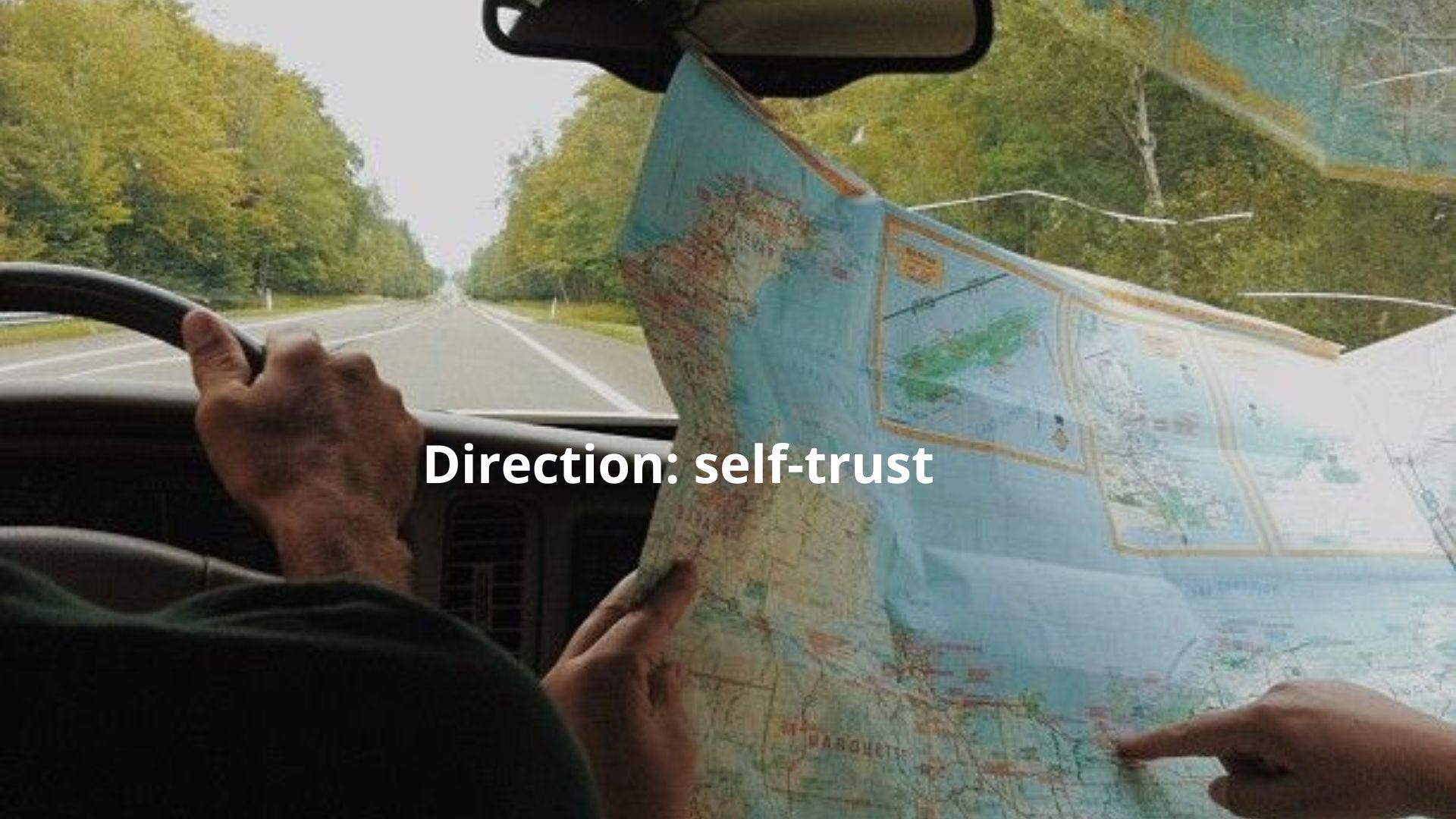
Direction makes decisions easier
I heard from a psychologist one of these days that people struggle to make decisions in their lives, like staying or leaving a relationship, job, country, etc., when they don’t have a clear vision of the life they want for themselves.
A vision doesn’t need to be specific to its core, but it needs certain direction. A great way to find direction is to think about your values, aspirations, and dreams. Once you have it laid out, it’s easier to decide what feels right and aligned in the moment. Even if it changes later.
Warmly,
Nat
I'm curious, tell me: what's your way of making a decision when you feel stuck or unsure?
The letters Circle 💌
If you enjoyed this piece, subscribe & join The Letters Circle to receive physical letters 💌 with self-discovery practices every month in your mailbox 📮

Thank you for sharing this, Nat. I found your message right when I needed it. Lately, I've been simplifying my perspective. Can I turn this into a yes-or-no question? And asking myself which response resonated. I use that to help me reclaim my trust and independence.
Yes yes yes! Totally agree with everything you’ve said here. I’ve learnt over time that a decision made is better than indecision, and actually a decision not made is a decision in itself (but not always a great one).
For me, something that helps avoid the analysis paralysis is to frame any decision I make as one that I make ‘with the best available information I have right now’ and then I tell myself it’s the decision I can make with what I’ve got, and if it’s OK to change my mind or pivot if I were to have new available information.